
Exiled Bangladeshi author Taslima Nasreen has strongly advocated for the implementation of a Uniform Civil Code (UCC) in India, Bangladesh, and Pakistan, citing its importance in eliminating discrimination, especially against women. Her remarks come as the West Bengal government examines a draft UCC. Nasreen also expressed dismay over a disruption at her felicitation ceremony in Kolkata, where poet Joy Goswami was prevented from speaking.
A nine-judge Supreme Court bench has commenced hearing on petitions related to discrimination against women at religious places, including the Sabarimala temple, and the scope of religious freedom across faiths.

The Kerala high court has delivered a landmark judgment, empowering Christian women in India to file for divorce from their current place of residence, thereby removing a significant procedural hurdle and ensuring equal access to justice.

The much sought after H-1B visa programme, particularly among Indian technology graduates, discriminates against women.

The Supreme Court has directed the Indian Coast Guard (ICG) to consider granting permanent commission to Short Service Appointee (SSA) officer Priyanka Tyagi and other similarly placed women, pending vigilance clearance. This follows earlier strong remarks from the court against the ICG's "vague" and "arbitrary" policy regarding women officers, emphasising gender equality in the armed forces.

The Supreme Court of India has dismissed the use of information from 'WhatsApp University' as evidence in a case concerning religious freedom and discrimination against women at religious sites, including the Sabarimala Temple.

Samajwadi Party president Akhilesh Yadav criticised the BJP government's record on women's safety, alleging increased crimes and discrimination.

The Centre has supported the restriction on women of menstruating age entering Kerala's Sabarimala temple, arguing that the Supreme Court's 2018 judgement assumes male superiority.

The Supreme Court of India has expressed concern over the continued prevalence of domestic abuse and crimes against women, highlighting that these issues are symptomatic of a deeper societal problem rooted in patriarchy, despite economic and legal advancements.

The Arunachal Pradesh Legislative Assembly has strongly condemned racial discrimination against people from the Northeast and urged the central government to enact a stringent anti-racism law.
Dismissing discrimination charges levelled against it, Hockey India on Friday said it will pay the protesting women hockey players at par with their male counterparts once it has the fund ready.

UN Women has issued a stark warning that the rapid advancement of artificial intelligence (AI) is placing women at a higher risk of discrimination and digital violence, citing studies that reveal significant gender bias in AI systems and large language models.

IIT Bombay has removed Suryanarayana Doolla, Dean of Administrative Affairs, from his post and issued a public apology following the death by suicide of 22-year-old student Sahil Wakode, who his parents allege faced caste-based discrimination.

Congress leader Rahul Gandhi urged girl students to "smash patriarchy" and criticised the "Manusmriti mindset" during an interaction in Pune, highlighting issues of sexual harassment, safety, and economic independence for women.

UN experts have voiced serious concerns regarding the ongoing abduction and forced religious conversion through marriage of women and girls from minority communities in Pakistan, highlighting that impunity is fuelling the practice.

A nine-judge Supreme Court bench has reserved its order on petitions related to discrimination against women at religious places, including the Sabarimala temple, and the scope of religious freedom.

Parliamentary Affairs Minister Kiren Rijiju met Leader of Opposition Rahul Gandhi to discuss resolving the persistent deadlock in the Lok Sabha's monsoon session, focusing on the Delimitation Bill and FCRA Bill, though no immediate commitment was secured from the Congress leader.
The Supreme Court of India has observed that the practice of excommunicating Parsi women for entering into interfaith marriages is prima facie discriminatory, emphasising that the right of conscience is a birthright.
The Supreme Court has stated it will wait for the central government's response on petitions concerning the criminalisation of marital rape before scheduling a hearing. This comes as the Centre has yet to file a substantive reply on the matter, which challenges the constitutional validity of exceptions in criminal law that protect husbands from prosecution for sexual acts with their wives. The issue involves the interpretation of Section 375 of the IPC (now replaced by Bhartiya Nyaya Sanhita) and has seen split verdicts in high courts.

The Supreme Court has agreed to hear a plea on May 29 seeking a direction to the Nagpur Parsi Panchayat to treat a Parsi woman equally with her male counterparts, even after she marries a person of another faith, challenging a rule that allegedly strips Parsi women of their religious identity upon inter-faith marriage.

NDA leaders have defended proposed amendments to the Women's Reservation Act and the Delimitation Bill, 2026, arguing women have waited long enough for reservation, while opposition parties allege the process could undermine India's federal and democratic structure, particularly impacting southern states.
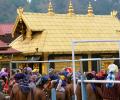
The Supreme Court is hearing petitions related to discrimination against women at religious places, including the Sabarimala temple. A nine-judge bench is examining the scope of religious freedom and the exclusion of women based on age and menstrual status.

The Supreme Court questioned the chief priest of the Sabarimala Ayyappa Temple regarding the constitutionality of preventing believers from touching the deity, during hearings on discrimination against women at religious sites.
The Supreme Court of India has stated that religious institutions must have structure and norms for their functioning, emphasising that the right to manage a religious institution does not imply an absence of order.

A Reddit post about a hidden camera in a shared living room has reopened an old question -- how far can a landlord interfere in a home he no longer fully controls? Here's what two Mumbai lawyers have to say.
The court will consider issues related to entry of Muslim women into mosques, female genital mutilation in the Dawoodi Bohra Muslim community and barring of Parsi women, married to non-Parsi men, from the holy fire place at Agiary.

BJP MP Tapir Gao has called on the central government to enact a law to protect people from the northeast from discrimination and atrocities outside their home states, following an alleged assault on a Manipuri woman in Delhi.

Eiffel Tower employees launched a strike, leading to the iconic landmark's closure, after allegations surfaced that female staff were asked to vacate their posts during a visit by the Hindu religious organisation BAPS.
The Supreme Court observed that Hinduism is a way of life, stating that mandatory temple visits or rituals are not necessary to be considered a Hindu; even lighting a lamp at home suffices.
The Travancore Devaswom Board (TDB), managing the Sabarimala temple, argued in the Supreme Court that religious beliefs should be judged subjectively by the community, as the court hears petitions related to discrimination against women at religious places.

Goa's chief minister Laxmikant Parsekar says being dark affects a girl's marital prospects. Have you been at the receiving end of such discrimination?

The Supreme Court of India has asserted its jurisdiction to determine what constitutes a superstitious practice within a religion, during a hearing on petitions related to discrimination against women at religious sites.
The Supreme Court of India questioned the Centre regarding the eligibility of non-devotees to challenge the customs of the Sabarimala temple in Kerala, during a hearing on religious freedom and discrimination against women at religious sites.

The Supreme Court has announced that a nine-judge bench will begin final hearings on petitions related to discrimination against women in religions, including the Sabarimala Temple case, starting April 7.
The Supreme Court of India has voiced concerns about the potential consequences of individuals questioning religious practices in constitutional courts, warning it could lead to the fragmentation of religions and civilisation. A nine-judge Constitution bench is hearing petitions related to discrimination against women at religious places and the scope of religious freedom.
The Shabari story in the Ramayana found mention before a nine-judge constitution bench of the Supreme Court on Wednesday while hearing petitions related to discrimination against women at religious places, including the Sabarimala temple in Kerala.

Prime Minister Narendra Modi has appealed to the opposition to support the government's bills for implementing the women's reservation law, cautioning against politicisation and assuring that delimitation will be fair to all states.

A Constitution Amendment Bill aimed at implementing 33 per cent reservation for women in legislatures and increasing Lok Sabha seats was defeated in Parliament, marking a setback for the government's efforts to empower women in politics.

The Vishva Hindu Parishad (VHP) has appealed to the United Nations to intervene on behalf of religious minorities in Pakistan and Bangladesh, citing human rights violations.

The Wrestling Federation of India (WFI) has reversed its decision and allowed Vinesh Phogat to compete in the 53kg category at the Asian Games selection trials.
